Showing posts with label In Search of the Unknown. Show all posts

Wednesday, 8 January 2014

Silver Marches Sandbox 14 - Tombs of Deckon Thar


Edit 10Jan14: If you are interested in this post, I would actually suggest reading the next post - Silver Marches Sandbox 15 - Reavers of Harkenwold & The Caves of Chaos - simply because I think Tombs of Deckon Thar works better as the fourth part of that adventure as suggested at the end of that post.


Some hours ago I posted a revised introduction to this campaign where I included mention of the Zhentarim presence in Silverymoon Pass as part of a Netherese plot to disrupt trade between and among the three major cities of Silverymoon, Sundabar and Everlund.In turn, this built off an idea I had when I posted some thoughts about adapting B2 Keep on the Borderlands for use as part of a sandbox campaign in the Silver Marches. 

(I actually need to revisit that post because I largely dismissed the idea of Zhentarim involvement because I wanted to avoid having a lot intrude on my plans for a sandbox. I have obviously dismissed that plan....)

Now I am looking seriously at the Silverymoon Pass as a place to set one or more other adventures that build off the plot point that the Zhentarim are present - and on the Netherese payroll - and that they have been hired to disrupt trade. Humanoid raiders are useful for that - and I shall return to my homage to the Keep on the Borderlands in the next few days and offer some updated thoughts - but undead can also be terrifying, implacable foes who simply do not care less about bad weather unlike orcs, goblins, human bandits et al. (And while I have neglected included any ideas based on the weather so far, I do plan to adapt the section dealing with weather from 3E's Silver Marches for this campaign.)

And that brings me to the Tombs of Deckon Thar so conveniently located about halfway along the Silverymoon Pass.

The Tombs of Deckon Thar first appeared in a 1E publication, REF5 Lords of Darkness:


Despite being one of the first supplements published for FR, this work used little from Ed Greenwood and was instead written by TSR staffers and/or freelancers. It seems to suffer for this as it does feel particularly FR-ish. 

Lords of Darkness provides the following background for the Tombs:
After the breakup of the Lost Kingdom, a bandit culture took root in the mountains between what is now Silverymoon and Sundabar. Even then, these were relatively large population centres which traded between themselves, and the Chieftains in Gold, as the bandits called themselves, grew rich either raiding the trading caravans or charging high tolls for their safe passage, depending on how accommodating the rulers of the trading lands were.

For eight generations these chieftains led their people in this activity, but eventually they were caught in the path of an orc horde and are said, in ballads, to have died fighting to the last man, woman, and child.
 

The orcs looted the chieftain's’ great keep in the mountains, but no one has ever discovered the tombs of the seven chieftains who died before the orc invasion.
I don't recall there being a Lost Kingdom in the North; I'll read that as the fall of Netheril instead.

The Tombs are then described as a series of burial mounds linked by tunnels and inhabited by wights. This is the map that comes with the adventure:


And this is the more colourful version provided with the Forgotten Realms Interactive Atlas:

The wights are noted as being ruled by the Mound King, a more powerful wight named Vinjarek (although the spelling was changed to Vinjarak in 3E) who wields an intelligent broadsword apparently of dwarven manufacture named Deepchill. While not described as such, I think it's supposed to be a frost brand sword.


The description of the Tombs was updated slightly in 4E on page 147 of the Forgotten Realms Campaign Guide:
Seven wight-haunted tombs shudder in the cold grip of the Mound King, a plaguechanged wight with powers unknown but whispered to be terrible. The tombs were once the secret hoards of bandit lords called the Chieftains in Gold, who dominated the western Nether Mountains centuries ago. They sallied from a great keep and buried their dead in barrows filled with ill-gotten loot. One of the seven tombs was plundered by a group of salvagers, and vengeance found them all as they made their way back to their Silverymoon base. In each case, the dismembered corpses were discovered, sans loot and equipment, with the message “Disturb not the Mound King” inscribed in their flesh.
I think I will ignore the reference to plaguechanged as I basically plan to ignore the Spellplague in this campaign. The "Disturb not the Mound King" warning is interesting; it does offer an alternative adventure hook should I need it. And on that note, I can segue nicely into the subject of making this into an adventure for this campaign.

As noted earlier in this post, trade is being disrupted in the Silverymoon Pass by a variety of raiders and that strife is being caused by the Zhentarim as part of a contract they have accepted from the Netherese. Zhentarim necromancers and/or Cyricist clerics have also travelled to the Tombs of Deckon Thar and performed evil necromantic rituals to awaken the Mound King and his vassal wights. These undead are now also raiding the Silverymoon Pass and are controlled by powerful ritual circles inscribed in their tombs.

If these ritual circles are broken, the undead are freed from Zhentarim contol and, indeed, they will extract their vengeance from their erstwhile Zhentarim masters. Rather than the PCs simply attacking everything they encounter directly, they can perform skill challenges to break the power of the rituals and find that the undead will largely take care of the Zhentarim for them. I'm not sure if new players will figure this out but I think with a few skill checks and half an idea I would be willing to provide them with a bit of guidance. After all, that sort of play is an important lesson to learn and one of the joys of tabletop RPGs.

And that's about it. I don't think it has to be much more complicated than that but I think I will also revisit the maps when/if it come time to run this adventure.

Edit: The Mound King

Vinjarak the Mound King is a creature of mystery. Why not make him an undead anti-paladin of Kozah with some storm-based powers? Perhaps his awakening also triggers magical storms throughout the Silverymoon Pass?

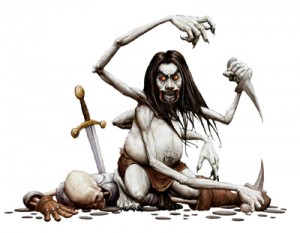
And here's a possible picture of him courtesy of Paizo:


Tuesday, 7 January 2014

Silver Marches Sandbox 13 - The Shattered Circle

There is a perception that there was a lot of absolute dross produced during the AD&D 2E glut as TSR tried to stay afloat after a decade or more of complete mismanagement. And that's probably true but there are some absolute gems - diamonds in the rough, as it were - that are easily overlooked from that time. The Shattered Circle, IMO, is one of those.

Here is the cover which links to its page on dndclassic.com despite not currently being available for sale:

http://www.dndclassics.com/product_reviews.php?products_id=17104&it=1

Despite being published toward the end of 2E's lifespan, this is, in many ways, a classic 1E adventure. There is essentially no plot or story: this is simply an interesting location that is ready to be explored and with room for a DM to add his own plot on top, should he so desire.

Location, Location, Location

Here's the upper-level and side-view of the entire dungeon:

The dungeon is supposed to be an ancient ruin. In a Forgotten Realms context, I would make it date back to the time of the Creator Races and, more specifically, make it a sarrukh ruin. (The sarrukh were the reptilian creator race and, inter alia, the creators of the Serpentfolk. They were more fully described in the excellent Serpent Kingdoms.) But the dungeon, with its upper level and lower levels are not the real attraction of this adventure. This is:


Right in the centre of the dungeon, between the two levels of ancient ruins, is this web-city of the chitine. The chitine are a spider-like race of humanoids created by the drow as part of some sort of experiment perhaps to create a slave race. The backstory is not so important: I just love the fact that the PCs explore this dungeon and suddenly discover a giant spider egg-sac turned into a city.

Here's the rest of the dungeon:


The web-city is not mapped but it probably doesn't need to be. After all, who in their right mind would go in there? What is interesting, though, is if the players decide that they want to destroy the city. Are those webs flammable like spiderwebs? Will a well-placed fireball simply cause the whole thing to go up in flames? Can the webs that are suspending the sac-city in the air be severed by other means?

I think this is one of those situations where I would prefer not to work out the answers in advance. Instead, I think I would rather listen to the players' ideas and simply respond. For now, that's the way I will leave it.

Encounters

With a web-city in which to live, clearly this dungeon needs to include chitine and probably lots of them. I think they simply have to represent the majority of encounters. I haven't decided on what level they should be: they're level 5 in 4E (IIRC) and they began as a 2 hit dice monster when introduced in 2E. I'm inclined to make them level 2 to match their 2E hit dice and also because I see this as an early adventure for levels 1-3 (although it does look tough for level 1; perhaps levels 2-4 instead?).

These are the chitine:


The chitine are ruled by a priestess class - no doubt inspired by the priestess-rulers of the drow - called choldrith which seemed to have been introduced in 3E with 4 hit dice. They appear like this:

 
One of these could be the queen at the centre of the web-city and she would only be seen if the PCs were captured and brought before her and/or they decided to try and destroy her city. From memory, they were noted somewhere as being able to control carrion crawlers. Anyway, assuming that these spiderfolk have a spider's appetite for blood, that suggests that the husks of bodies will be thrown away. This could easily attract carrion crawlers and similar garbage-eating creatures.

One of the key conceits of the original adventure was that a powerful, immovable artefact had been discovered where it had been buried - and it is powerless when buried - called The Foundingstone. One of this object's powers was the ability to reach back into the past and summon creatures that existed at that time. In the adventure, this is used to explain the appearance of, inter alia, dinosaurs.

While I normally avoid anything related to time travel, I quite like this in the context of this being the ruins of some sarrukh-created facility. It's also a good excuse for having monsters "respawn" and then the PCs face a fresh challenge: how to prevent the respawning? And here's The Foundingstone with its werespider guardian (an odd touch, and one I do not plan to keep):


I'm also tempted to include one or more undead sarrukh, inspired by the Immortal King in the classic adventure Caverns of Thracia, and also by this picture:


So, we have chitine, carrion crawlers, dinosaurs from beyond time and a strange serpentfolk mummy. It's enough to start with but it probably need a few extra monster types as well as a lot of dungeon dressing... and the mention of Caverns of Thracia is enough to make me start thinking how easily this site could form the basis of a megadungeon. So very tempting....

What About Plot?

In my last post, I provided a revised introduction for this campaign including, inter alia, a plan to include the drow and have them motivated by Lolth's desire to create the Demon Weave and then take the portfolio of magic that previously belonged to Mystra.

An artefact like The Foundingstone would be perfect for the Demon Weave. In fact, it might even be the cornerstone of Lolth's new creation. I've always had the Creator Races possessing a level of magic that has never since been equalled in the Realms and I see The Foundingstone as being of that ilk.

What if the chitine have found it and their choldrith queen has used whatever the 4E equivalent of commune is to seek the advice of Lolth. The Queen of Spiders considers the chitine to be little more than cast-offs so she instructs her favoured drow to come and take The Foundingstone and sacrifice the chitine to her as part of the Demon Weave ritual.

When the PCs begin exploring, the drow also begin exploring too adding another encounter type to the mix. But perhaps The Foundingstone senses the presence of the drow and Lolth's plan for it and so it starts summoning creature's from Toril's distant past to defend itself from the drow and whoever - or whatever - else might try and take its power. Perhaps the undead sarrukh awakens and strikes some sort of bargain with the PCs to drive off the drow?

Like any of my suggestions, it's hardly original but it will probably work as a combination of light plot and backstory. Otherwise, I am at a loss as to why the PCs might continue exploring this location. Even as part of the Demon Weave plot, there's no sense of urgency here; it's just an interesting location.

Finally, I probably should have mentioned this already, but my current plan is to place this within the Silverwood and, if circumstances allow, run it after my homage to Raiders of Galath's Roost or whatever other adventure I decide to use to open the campaign. I just hope that when sit down to write this up properly, I don't find myself getting excited and inspired by the reference to Caverns of Thracia and turning this into a megadungeon....

Silver Marches Sandbox 1A - A Revised Introduction

When I started this series of posts I began with a simple introduction that, twelve or so posts later, feels in need of an update.

As I have been putting down my ideas for this campaign in these posts, and also thinking about other ideas as I go about my daily business, I am finding that some things are taking on a more definite shape primarily in relation to background information and the identities and activities of antagonists. That said, I still want to try and keep the sandbox feel - conscious, too, that that is such a vague term - but there are antagonists and there are things going on in the background so why not give them a little bit of detail.

Behind-the-Scenes: What is this All About?

I am no fan of WotC's adventures. Generally speaking, they suck. Even WotC seems to agree as there have been public comments about the need to publish better adventures particularly with the dog's breakfast known as D&D Next (aka D&D Previous, aka D&D Fifth Edition, aka AD&D Third Edition etc...) scheduled to be published later this year. This seems to be the sink or swim edition for D&D at WotC in the face of demands from Hasbro to turn D&D into a genuine moneyspinner.

Anyway, corporate crap aside, WotC needs to produce better adventures for the new edition. It cannot afford another Keep on the Shadowfell or (the even more execrable) Pyramid of Shadows so I have been watching the few Next (pre-Next?) releases carefully.

The first one that was widely available was Murder in Baldur's Gate. It sucked. It blew chunks. It was not an adventure. And yet some people enjoyed it. Good on them. :)

But then came the second: Legacy of the Crystal Shard. Wow. This was an adventure - actually, a mini-campaign - that I could really enjoy. It got my creative juices running to the point where my largely dead blog had a burst of new life in the form of a series of posts suggesting ways to expand Legacy of the Crystal Shard with some other published adventures.

But Icewind Dale is relatively small and, as I am not a R A Salvatore fan (with the exception of The Crystal Shard), the area doesn't hold my interest. Plus, as I thought about some of my posts, I realised that the ideas would work even better in the Silver Marches. The final clincher for using the Silver Marches was, simply put, the superb map created by Mike Schley.

This is the map Mike Schley created:

It's simply superb.

And this is the shitstain, if you will pardon the language, excreted for 4E's Forgotten Realms Campaign Guide:

It's one thing to destroy the Realms with the Spellplague and the other 4E changes (frankly, I understand why these were done and the fact that I use the 4E Realms shows I can work within those changes). It's another thing to then map the world using the contents of a baby's nappy/diaper.

Focussing on the positive, I can work with Mike Schley's map and it's something I can show to new players and give them a decent overview of the region their characters will be exploring. And that's a good segue into my next major point, I am planning to run this campaign for players new to tabletop RPGs and to the Realms.

And while I plan to use either 4E or 13th Age to run the game (and I am leaning toward 4E because, despite its greater complexity, I think grid-based combat is a great way to learn tactics), I want to try and include a lot of old school influences primarily by adapting old 1E and 2E adventures. Other than the ruleset, anyone who plays this campaign should be having similar experiences to someone who started playing D&D in the 1980s like I did.

That also means I want to include a lot of the so-called clichés (aka tropes) of D&D and the Forgotten Realms. There will be dungeons and there will be dragons. There will be drow and the Underdark. There will be slavers (and Slave Lords) and the Zhentarim. There will be beholder and mind flayers and other monsters from the first Monster Manual. And, of course, there will be bugbears, goblins, hobgoblins, ogres, orcs and giants.

And these monsters will be fought in homages to, inter alia, B1 In Search of the Unknown (for which the campaign is named), B2 Keep on the Borderlands, D1 Descent into the Depths of the Earth, D2 Shrine of the Kuo-Toa, D3 Vault of the Drow, G1 Steading of the Hill Giant Chief, G2 The Glacial Rift of the Frost Giant Jarl, G3 Hall of the Fire Giant King, and Night Below.

Plot, Metaplot & Subplot

When I started thinking about ways to create a sandbox in the Silver Marches that would basically involve throwing existing adventures on to Mike Schley's map, I made a conscious choice to avoid issues of story or, as I have termed it here, plot, metaplot and subplot (a paraphrase, in the loosest sense, of the legendary Winston Churchill's comment about "rum, sodomy, and the lash"). However, as my ideas involve, inter alia, the drow, the Netherese and the Zhentarim I do need to give this some attention.

The Zhentarim

Tackling them in reverse alphabetical order, I will begin with the Zhentarim because they are the simplest.

Normally when I involve Zhentarim in my campaigns they are a major enemy and may even provide the ultimate BBEG of the campaign. At the moment, that is not my plan for this campaign. Rather, my plan is to use them as they are found in the 4E Forgotten Realms Campaign Guide: they are purely a band of mercenaries with no principles preventing them from being hired by even more evil groups. 

In this campaign, they have been hired by the Netherese to cause strife in the Silver Marches by disrupting trade between and among the three major cities of Silverymoon, Sundabar and Everlund and also along the River Rauvin by acting as river pirates. And that's it. There is, at the moment, no grand scheme for the Zhents in the Silver Marches other than fulfilling this contract for the Netherese. Even the Cyricist clerics that are part of the Zhentarim are happy simply to spread strife in accordance with the Dark Sun's dogma; being paid to do so is just a bonus.

This may change later - I still have plans for a campaign involving a new clone of Manshoon taking over the Zhentarim and turning them into what they were before the Spellplague, including making them Banite rather than Cyricist - but I don't think that will happen in this campaign. Here they are bad buys, but not as bad as other groups that the PCs will encounter.

The Netherese

As noted, the actions of the Zhentarim in the Silver Marches are due to a contract from the Netherese, also known as the Shadovar.

The Netherese are noted worshippers of Shar, the Mistress of the Night, who is fundamentally opposed to her sister Selûne, also known as the Moonmaiden. As Silverymoon and, indeed, the Silver Marches, are considered to be strongly aligned with the Moonmaiden. the Shadovar plan to bring the Silver Marches under Netherese rule have a strong religious element amongst the more diehard Shar-worshippers among them.

More importantly for a growing empire like that of the Netherese, the Silver Marches is rich with natural resources, the same resources that have attracted dwarves - and, indeed, dwarven kingdoms - for many millennia. Similar, the Silver Marches is rich in magical resources which attracted the original Netherese to this region two or so thousand years ago.

The use of the Zhentarim to disrupt trade and cause strife is merely an opening gambit by the Netherese. They also plan to stir up the giants and the orcs while simultaneously preparing their own forces to invade once their catspaws have done their jobs. And any prospective Netherese invasion will not come by land: the Shadovar plan to send a flying city when the time is right. (And perhaps one of things they are searching for in the Nether Mountains is a ruined flying city that can be repaired....)

I don't think the invasion will form part of the campaign: that's really just backstory to justify or explain Netherese actions in the Silver Marches in case the players become interested in that part of the story.

The Drow

Right now, I am planning to use the Rise of the Underdark storyline as the major metaplot of the campaign. A large part of this is because I want to run homages to D1 Descent into the Depths of the Earth, D2 Shrine of the Kuo-Toa, and D3 Vault of the Drow - with Menzoberranzan taking the place of Greyhawk's Erelhei-Cinlu - but also because they are a threat powerful enough to justify the Netherese losing interest in the Silver Marches.

The guts of the Rise of the Underdark story is this: Lolth wants to become the new deity of magic, taking the place of the now-dead Mystra (bear in mind that I am setting this game in 1479 DR before Ed Greenwood [apparently] brings back Mystra in one of the Elminster books) and creating something called the Demon Weave which is a replacement for the former Weave and which, I suspect, draws some of its power from the Abyss and/or Lolth's Demonweb Pits.

This Demon Weave is to be created and/or fuelled by sacrificing powerful magic to Lolth and by draining off the power of imprisoned primordials and other creatures of power. I like this basic idea because it explains the reasons for the drow being involved anywhere and in almost anything. It also means that if the PCs obtain powerful magic for themselves, they might find drow assassins on their tail sent to recover said magic from them.

My plan with the drow is to focus on House Xorlarrin, largely because they are noted as being the most powerful arcanists in Menzoberranzan and their motivation for being away from Menzoberranzan is easy to understand (and, at the appropriate time, to explain to the players). The nature of the Demon Weave also means I have a good excuse for revisiting the demonic eladrin known as the fey'ri and the demonic orcs - or tanarukka - of the Scourged Legion.

TL; DR: Over the course of the campaign, the PCs will encounter drow doing things necessary for the creation of the Demon Weave and one possible logical conclusion of the campaign will be to have the PCs adventure through a 4E homage to D1 Descent into the Depths of the Earth, D2 Shrine of the Kuo-Toa, and D3 Vault of the Drow with a goal of ending the threat of the Demon Weave. That may take the campaign beyond my plan to focus on the Heroic Tier into early Paragon Tier but I will only do it if the enthusiasm from the players is there.

4E vs 13th Age

Firstly, I should make it really plain that I am writing these posts with a plan to run this game in beginning in 1479 DR, the Year of the Ageless One, which is the default start year for the 4E Forgotten Realms Campaign Guide.

Secondly, I am writing these posts from the perspective of running the game using D&D 4E. That said, I may end up using 13th Age instead - in many ways it would be better for new players - but for the moment I am focussing on 4E. I may, however, post some ideas for a 13th Age version as time goes by.

Thirdly, I custom build almost all of my 4E monsters primarily because I want to run a game aimed at the Heroic Tier and I basically believe that 1E got the hit dice of most monsters right. As a result, my monsters are basically the same level as their number of hit dice in 1E which may help to explain why I think, for example, that a conversion of D3 Vault of the Drow can be used with PCs at the end of the Heroic Tier/beginning of the Paragon Tier.

So, if 13th Age is easier for new players why am I planning to run 4E?

My plan for this game is to use it to introduce my wife and her family and our friends here in the Philippines to tabletop RPGs. They're familiar with a clone or add-on to World of Warcraft called Dawn of the Ancients but have no concept of a pen and paper game. Actually, with the exception of cards, they have no working knowledge of any non-computer games. It's a different culture, particularly here in one of the more Third World parts of a Third World country.

For some reason, I think the visuals offered by miniatures and map tiles are going to be key to "converting" my prospective new players into actual tabletop roleplayers. Maybe I'm right and maybe I'm wrong; I suppose I will find out soon enough.

One thing I am concerned about with 4E, though, is the sheer number of choices available to a player, particularly a new player. Hopefully I can design a decent cheat sheet for the players that will make that easier but, the simple fact is, I am going to doing a lot of hand-holding. Even something like the use of action points is an issue: I'll probably drop them for the first few sessions and give the PCs a +10 damage bonus to their first significant attack each encounter to make up for the lack of action points.

Of course, another option is simply to use miniatures and 13th Age together but that just doesn't seem right. 

Wrapping This Up

I am excited by the prospect of a campaign in the Silver Marches. It's a nearly perfect setting for adventures due to its history of dwarven, elven and Netherese empires which ensures that even the existence of traditional dungeons makes sense. Couple that with a landscape almost designed for dragons, giants and orcs and you have a classic setting for D&D in whatever form you prefer.

I also want to write more this year and I find that blog posts are a good discipline for me even though this is completely unrelated to my real life. It's a creative outlet and it's good writing practice. Also, having the basic framework of the location shown on Mike Schley's map and simply finding things to write about locations on that map makes it a lot easier to come up with an idea for a blog post. After all, there are over 100 named features and locations which means I can easily find at least 100 things to post about. 

Silver Marches Sandbox 12 - Raiders of Galath's Roost

One of my absolute favourite adventures of all time is the 3E adventure Raiders of Galath's Roost published in Dungeon 87. I am biased because it involves the Zhentarim - they are, simply put, my favourite D&D organisation of all time - but, for me, the real attraction is that it is, like the Caves of Chaos from B2 Keep on the Borderlands, so portable and useable in almost any location or, indeed, in any world.

Part One: Galath's Roost

The set-up is simple. The titular raiders are attacking the Dalelands but, when pursued, they cannot be found. This is because they are using a portal - no surprises there - near the ruins of the titular (that word again) Galath's Roost which includes both a small surface level and a slightly larger underground level.

Here are the maps from the first part of the adventure:


That's the surface level and some of the surrounding wilderness. In the original adventure, the surface encounters include some drow scouts who are also investigating the raiders.


And that's the dungeon level. The maps are quite simple but easy to adapt for a variety of settings. More on that below.

After the PCs investigate Galath's Roost and discover the portal and its method of activation, they can travel via the portal to the raiders' base, a Zhentarim fortress in the mountains nearby.

Part Two: The Zhentarim Fortress

The portal leads to a Zhentarim fortress which spreads out over three levels. I rather like the maps and I like the thought that has gone into, for example, having the portal open outside the fortress on a piece of ground separated from the entrance to the fortress by a sheer drop that can be crossed with difficulty, with magic or by lowering a drawbridge. It's a good way to make the players stop and think:


The fortress as seen here is quite large with a lot of encounters - and that's before looking at the other levels. Even in 3E I had to modify it on the fly to remove the grind; that's an even bigger issue in 4E unless a lot of minions are used.

The fortress also has an upper level which is perfect for overlooking the arrival area:


It also seems designed to handle flying creatures. Perhaps there is a Zhentarim skymage in residence?

My favourite level is the dungeon level with its Banite sacrificial chamber shaped like a hand:


That cage-like area on the floor represents a grille over an oubliette where ghouls are kept. The adventure actually provides an illustration for this:


The primary goal in the fortress is to defeat the Zhentarim whose leader is a cleric of Bane (this is pre-Spellplague, of course, when the Banites, rather than Cyricists, were in charge) who is illustrated in the adventure's cover art:


Even though the colours are wrong, I love this illustration because it really captures the arrogance and superciliousness of a cleric of Bane, and I like the dire rat beast of Bane hiding behind the cleric's legs. R K Post does good work.

Part Three: Fitting this in the Silver Marches Sandbox

The beauty of this adventure with its RUIN + PORTAL + FORTRESS model is that it can fit almost anywhere. The Silver Marches is full of ruins and the use of a portal to travel to the fortress means the fortress can be in any of the mountains of which there are plenty.

However, I've been trying to think of an introductory adventure for a prospective Silver Marches campaign which will begin in the city of Silverymoon. I've already posted a couple of ideas for using B1 In Search of the Unknown and B2 Keep on the Borderlands as starter adventures but, in keeping with the sandbox theme, I want to be able to present the PCs with other options.
 
The Silverwood
 
Also, looking at the map of the Silver Marches I am using, the geographical feature that stands out near Silverymoon is the Silverwood. Strangely enough, despite its proximity to one of the most storied and developed cities of the Realms, next to nothing has been written about the Silverwood. In fact, all I can find boils down to this:
The land rises at the edge of the Trollmoors (aka Evermoors) and a small forest made up almost entirely of of silver birch trees covers the rise. Trolls from the moors below continue to roam in this wood, but there are other terrors as well. The eastern side of the woods ends in a sharp escarpment which drops down to the River Rauvin and Silverymoon.
I'm not sure of the canon source for the silver birch trees but the rest seems consistent with what I recall reading. And silver birches fit both in terms of the name of the Silverwood and the prevailing climate so I will be keeping this entire description. 

The Raiders

Looking at the map and reading the description above of the Silverwood, it's clear that the Silverwood overlooks the River Rauvin which makes it a prime location for river piracy. Trade flows down the River Rauvin and, wherever there is trade, there are criminals seeking to profit from it.

I rather like the idea of river pirates. The barges that are used on the river are relatively slow-moving (except in spring when the river is flowing because of melting snow and ice in the mountains) and they are difficult to manoeuvre.

At the risk of introducing more story elements into this sandbox, I already have in mind that I want to use the Zhentarim but these are not the well-organised, Bane-worshipping Zhentarim of pre-4E; rather, these are the more cell-like, Cyric-worshipping (or at least -tolerating) mercenaries of an organisation that has kept the Zhentarim name but is no longer the continent-wide threat it once was. (For now.) 

The Zhentarim in the Silver Marches are based in Newfort (this is a settlement that was introduced in 3E's Silver Marches and noted as being made up of settlers who originally hailed from Zhentil Keep) and are available for hire as mercenaries. I haven't given any thought yet to what they have been doing in the past but, for now, they have been hired by the Netherese to disrupt trade between and among the three major cities of the Silver Marches, namely Silverymoon, Everlund and Sundabar.

One of the basic ideas behind my plans for a clone of B2 Keep on the Borderlands is to have the titular keep be Hawk's Nest in the Silverymoon Pass but to have it taken over by the Zhentarim and used as a forward base for unleashing the humanoids they control (the humanoid lairs are, of course, the Caves of Chaos from that adventure) to bring trade in the Silverymoon Pass to a standstill.

Similarly, I think I could do much the same here with the ruin being the forward base for the Zhents and then the humanoid raiders arrive each day (or night) before being unleashed on the barge traffic on the River Rauvin.
And rather than using the Zhent fortress maps from Raiders of Galath's Roost, I am thinking of actually tying this into my version of Keep on the Borderlands and simply having the origin of the raiders be my version of the Caves of Chaos near Hawk's Nest thereby mashing Raiders of Galath's Roost and Keep on the Borderlands into a single adventure.

The major problem with this in the context of a sandbox is, of course, that it is strongly story-based. You have the link from the river raiders to the Zhents in the ruin then the portal leading to the Caves of Chaos and, finally, the Zhent headquarters in Hawk's Nest (and this also feels like it has some similarities with the plot of 4E's excellent Reavers of Harkenwold). At this point the PCs will probably find evidence that it was the Netherese who hired the Zhentarim to disrupt trade and that might suggest that the next adventure is against the Netherese.

I'll stop right there.

By simply making it so that the PCs can't work out how to use the portal, I can simply keep the river raiders (goblins? hobgoblins? orcs?), the ruin in the Silverwood with a Zhentarim leader and some bodyguards (this makes me think of Broken Spire Keep and the cleric Ranchefus in 2E's Night Below boxed set mega-adventure) and maybe have the ruin include a tomb of an eladrin or elven cleric of Moander from ancient Eaerlann that the PCs awaken as some sort of plant-based mummy that might even be potent enough to stat up as a solo creature.

Taken together, that's probably a fairly solid introductory adventure with a decent background, a nice mix of monsters and an unresolved mystery as to why the Zhentarim are using humanoid raiders to disrupt trade. And this picture from Night Below definitely makes me want to include Ranchefus or at least a cleric of Cyricist based on him:
Ranchefus, aka Yet Another Reason for Loving Arnie Swekel's B&W Work
Further Development

The easiest option to expand this adventure is to mash it up with Keep on the Borderlands and flavour it with Reavers of Harkenwold, as I have already mentioned.

Another option draws from Night Below and ties in with the Demon Weave storyline involving Lolth wanting to become the deity of magic - WotC's Rise of the Underdark event - and, while keeping the background elements already mentioned, have the underground level of this ruin in the Silverwood connected to the Underdark where "Ranchefus" is selling those his raiders capture on the river as slaves to the drow.

The idea here is not to pursue the drow all the way back to Menzoberranzan, but I do like the idea of taking on a band of drow slavers and then returning to Silverymoon to report to the city's leaders that the Zhentarim were behind the raiders and it seems that the drow were behind the Zhentarim. Who knows what might come of that?

And, of course, while it is probably seen as a horribly clichéd storyline for anyone who has played for a while, I think it could work really well with a group of new players. Anyway, the point in throwing around these sorts of ideas - in my brain or in a blog - is to simply to throw out options. A sandbox game lives and dies on options because you need options in order to offer players meaningful choices.

Similarly, the humanoid raiders don't even need to be led by a Zhent, nor does there need to be a portal linking them to another location. These could simply be orc raiders led by a shaman of Gruumsh, or goblins led by a hobgoblin (or even human) cleric of Bane or the leader may even be a fey'ri sorcerer seeking to obtain the resources to equip an army. There are river raiders. There is a ruin. It is in the Silverwood. Have fun from there.


Monday, 30 December 2013

Silver Marches Sandbox 9 - DL10 Dragons of Dreams

I must admit, generally speaking I despise the Dragonlance saga - Fizban, kender, railroads - and yet I recognise that there are some enormously creative set-pieces that I would really like to run one day. The problem though is, like George Lucas's prequel trilogy, sometimes the attempts to lighten the tone end up reducing everything to low (and unfunny) farce.

Yes Fizban, I am looking at you.

One of the set-pieces that I simply adore is found in DL10 Dragons of Dreams and it seems like something that would fit well in my Silver Marches: In Search of the Unknown campaign, particularly as a companion adventure to The Nameless Dungeon which I covered in two previous posts (part one and part two).

Background

3.5E's Lost Empires of Faerûn mentions the following in relation to the descendants of the fallen elven kingdom of Eaerlann who dwell in the High Forest in former Eaerlanni lands:
The Council of the Wood (Caerilcarn) is a group of wood elf elders and moon elf nobles who share a common dream of raising a new Eaerlann, a dream that is slowly coming to fruition. Through the group's efforts the settlement of Talltrees (the ancient site of kingdom's capital) was built and the new settlements of Reitheillaethor and Nordahaeril were founded. The Caerilcarn also cooperated with the army of Evermeet during the fey'ri invasion lead by Sarya Dlardrageth, successfully massing an army of wood elves at the Lost Peaks and breaking Sarya's pursuing orcish forces. The Caerilcarn is headed by Morgwais, the Lady of the Wood, and is led by its spokesman Yrind Morninglight.
I noticed this when I was looking at the background material for The Nameless Dungeon and I started to wonder what would have happened to this council in the century or so since the Spellplague particularly in the context of The Nameless Dungeon suddenly seeing some traffic again: why haven't these elves and eladrin noticed?

That made me think of my gaming bucket list and my desire to run DL10 Dragons of Dreams: the Caerilcarn and the wood elves and moon elves (aka eladrin) that it leads are no longer present on Toril. Instead, they are prisoners in a strange dream realm created by a potent eladrin lore-gem (a selu'kiira) in the possession of a green dragon warlock whose infernal pact is with Malkizid the Branded King:

Adapting the Adventure

In the original Dragons of Dreams, the elven lord Lorac Caladon stole an artefact known as a Dragon Orb and then found himself trapped by the artefact with his kingdom in some sort of nightmare realm. The adventure requires that the PCs either awaken Lorac or slay him so that his land may be freed from the Orb. 

To make it more interesting, the means by which Lorac can be awakened is determined by the players flipping three coins - to simulate their characters throwing three coins into a magical pond - and then the results determine what the PCs' three objectives are. I rather like this even though I won't be using it.

I think I will make this selu'kiira an heirloom of House Starym, a sun elf house known for its racism, evil and relationship with the (essentially) dead power Moander, the former deity of rot and corruption. An eladrin wizard of the Caerilcarn examined this lore-gem after it was recovered from an Eaerlanni ruin only to find that it overwhelmed his mind and, in a manner similar to that described for Lorac in the original adventure, used his nightmares (or at least the elven equivalent) to entrap all of the eladrin and elves subject to the rule of the Caerilcarn.

This nightmare realm exists entirely within the selu'kiira and the green dragon that possesses the lore-gem can use its power to entrap others (basically it is an attack vs Will with a single effect: the PC is removed from play... until escape!). And that's how the PCs end up inside... unless, of course, they defeat the green dragon first in which case they may find themselves entering the lore-gem willingly in order to free the elves.

Inside the nightmare realm it is essentially Groundhog Day for the entrapped elves. No matter what they do they find themselves alive and whole again. Even insanity lasts but a short time before the afflicted elf appears in his or her house as if having just left reverie. They are also unable to escape in and of themselves and need the PCs' help.

A short version could simply require the PCs to defeat a monster of some sort: another green dragon, a warped and twisted version of the eladrin mage who accidentally activated the lore-gem, or even an aspect of Moander. However, it might be better to require the PCs to perform a series of tasks that might include:
  • Bring hope back to the elves by defeating Treerazer, a fiend in the service of Malkizid which stalks and torments them "daily";
  • Purify a temple of Corellon (this could be a skill challenge) that is hidden in shadow and, indeed, haunted by shadow demons. This will give the PCs access to a scroll containing a High Magic ritual of purification - Daoin’'Teague'Feer: “Starshine Upon the People” which is described more fully in 2E's Cormanthyr - that the PCs will need to...;
  • Find the original mage who is now corrupted into a plant-like monstrosity by the power of Moander and perform the Starshine Upon the People ritual to cleanse him of this evil.
Treerazer does not appear in the original adventure but, rather, comes from the Second Darkness adventure path from Paizo for Pathfinder. I want to use Treerazer largely because of the art:
Treerazer's Rampage
The return of the New Eaerlanni eladrin and elves to Turlang's Wood should be a significant event in the campaign and the players should feel like their PCs are major league heroes for what they have accomplished. And I suspect that the elves will be rather generous with their rewards....

Possible Complications

I really like the idea of including the Eldreth Veluuthra - these are Nazi-like eladrin and elven supremacists - within the nightmare realm of the selu'kiira. What if they have completely given themselves over to the evil of the Branded King and thus they constantly harry the party as the PCs seek to free the other elves?

What if the green dragon warlock is able to enter the nightmare realm of the selu'kiira but, like the entrapped elves, is unable to be permanently slain there? The PCs may defeat the dragon only to find when they return to Turlang's Wood that it is not only very much alive, it also knows their battle tactics intimately.

Friday, 27 December 2013

Silver Marches Sandbox 5 - S4 The Lost Caverns of Tsojcanth & Grimlight's Lair

North northeast of Sundabar on Mike Schley's map of the Silver Marches is a point-of-interest marked as Grimlight's Lair. Grimlight's Lair is described in the web enhancement for 3E's Silver Marches and it is revealed therein that Grimlight is a behir of gargantuan size.

Any time I see a behir mentioned I automatically think of the cover art by Erol Otus for the 1E adventures S4 Lost Caverns of Tsojcanth:
Linking the two together, I'm wondering whether Grimlight's Lair might be an appropriate location to place an adapted/updated version of S4 The Lost Caverns of Tsojcanth with Grimlight the behir acting as a rather dangerous guardian of the entrance. Lost Caverns is fairly Greyhawk-intensive in terms of its backstory, but I think the location itself can be quite easily adapted to the Forgotten Realms as most of the backstory is largely irrelevant in the context of actually playing the adventure.

A Revised Background
During the Netherese era, the archmage Tsojcanth (for the moment at least, Tsojcanth is now a Netherese archmage... or is he?) explored the wilderlands north and west of Netheril seeking places of ancient, primordial magic. The region now known as the Cold Vale is a dangerous place of sudden deep gorges, many of which serve as lairs for trolls, leucrotta and worse. Among these gorges Tsojcanth found a ravine carved by a river, although the river has long since diminished and split into many smaller streams.
 
One of those streams still winds through the ravine, although it alternates between two different beds every few years. The walls of the gorge are fairly rough and climb steeply from the ravine’s floor to a height of 50 feet (the level of the surrounding land). The stream, which measures never more than about 2 feet deep, runs from the southwestern end of the ravine to the northeastern end. After another hundred feet it empties into a small pond, which drains through the rock into the Underdark.
 
The middle of the ravine has a hill, part of which has been hollowed out to form a small cave. That cave is now the lair of the legendary behir Grimlight but, more importantly, serves as the entrance to a series of caverns discovered by Tsojcanth that echo with powerful magic even in these years after the Spellplague.
 
What Tsojcanth discovered was a planar nexus that linked several different planes but was also, in some ways, outside of normal space and time. These properties made the caverns an excellent place to perform arcane experiments and also to hide powerful items as no divination magic - not even that possessed by a deity - was sufficient to penetrate the weirdness of this place. It also allowed Tsojcanth to walk between many worlds and ultimately he departed Toril after Karsus's Folly believing that magic in Toril was now dead.
With this sort of background, I suppose I can justify almost any encounter and almost any sort of final treasure. It's a lot less detailed than the background provided by Lost Caverns but I think it's sufficient for the purposes of a sandbox campaign, particularly one that isn't even set in Greyhawk!

The background also suggests that the Netherese that I have mentioned in my other posts in this series are likely to be involved. In fact, pursuing the Netherese might be the most appropriate hook for the PCs to follow. Alternatively, one of the Morueme family of blue dragon wizards from the eastern Nether Mountains might be involved or exploring the Lost Caverns could simply be a mission the PCs perform on behalf of someone powerful (and official) in Silverymoon.

Wilderness Encounters

The wilderness section of the original Lost Caverns was actually a fairly important part of the adventure, and it also tied in to the wilderness section of the "sister" adventure to Lost Caverns, WG4 The Forgotten Temple of Tharizdun (which is yet another 1E adventure I would like to adapt for this campaign).

Grimlight's Lair is set in different terrain - and on a different world! - to the original Lost Caverns so a lot of the encounters won't make sense but they can still inspire some encounters that are more appropriate to this campaign:
 
Barbarians
 
Uthgardt barbarians may be potential allies or little better than brigands depending on their tribe and/or inclination.

Border Patrol

Dwarves and humans from Citadel Adbar patrol this region in other to keep the trade roads between Adbar and Citadel Felbarr as well as Silverymoon free of bandits, barbarians, goblins, orcs and other creatures. These sorts of patrols should be fairly common.

The Craggy Dells

(This is essentially lifted whole cloth from Lost Caverns.)

This isolated place is one of rugged beauty, with rock spires and jutting mesas rising from a dish-shaped valley. The rock formations make the place a series of meadows and dells. There are scattered shrubs and a few copses of trees, but most of the area is covered with lush grasses. Game is common amidst the dells of the valley.

The towering peaks serve as home to a herd of hippogriffs. This group consists of a male and his harem. There are eight nests with a total of three fledglings in one pair of nests and four eggs in two others. This flock nests at the far southeastern edge of the valley.

A group of renegade humans and orcs, led by a particularly vile half-orc assassin, is currently camped in the Craggy Dells. They are capturing hippogriffs and fledglings to sell them later to certain powerful individuals (Netherese? Zhentarim?) who have promised to pay well for the creatures.

The Hermit

It wouldn't be a Gary Gygax-inspired adventure without a strange hermit. Perhaps this is some sort of spellscarred seer dwelling in his own personal plagueland, or perhaps a lonely druid who sees himself as the self-appointed protector of the Cold Vale.

Hobgoblin War Party

Led by a cunning warchief, this war party of hobgoblins is en route to destroy a band of orcs that have moved into territory claimed by the hobgoblins. And while I haven't given any thought to which tribe it might be, my plan for this campaign is to make sure any bugbear, goblin, hobgoblin and/or orc encountered belongs to a tribe and for the tribal affiliation to be reflected in the creature's appearance and, ideally, in its stat block.

Ogre Den

These ogres are unusual in that they are mercenaries for competing orc tribes taking the pay of one tribe each war season. They are surprisingly cunning in battle but that is because their leader is actually an ogre mage.

Troll Cave

This location should be given away by its stench. A hideous she-troll, possibly a cleric of Vaprak, leads a band of trolls who frequently menace travellers through the Cold Vale. There may be a significant reward for slaying these trolls on offer from the authories in Citadel Adbar and/or Citadel Felbarr as a result.

Wyvern Roost

A mated pair of wyverns with a clutch of three eggs hunts for meat to feed their soon-to-hatch offspring. If one of the wyverns is slain, the other will enter a berserk fury.

Hill Giants

The campaign is probably at a level by this point where encounters with hill giants (level 8 brutes IMC) are level-appropriate. They are hunters and raiders from the Rauvin Mountains.

Lesser Caverns
Lesser Caverns (Upper Level) of the Lost Caverns of Tsojcanth
The planar nexus nature of this location suggests that there is a lot of "leakage" from other planes. I can imagine that Far Realms creatures, in particular, would be attracted to this so I am thinking that aboleth would be a perfect fit for the Lesser Caverns, especially with there being so much water present.

I'm not sure how many encounters from the original I would keep but I do like the idea that there is a marid (water genie) imprisoned in area 22 who can be freed. That seems to be an appropriate reward for a party prepared to brave the dangers of the water... especially considering my plan to use aboleth.

Greater Caverns
Greater Caverns (Lower Level) of the Lost Caverns of Tsojcanth
The real attraction of this adventure is that the final treasure in area 20 can only be accessed once the puzzle of the teleporting doors is solved. While I am not sure yet what the final treasure will be, I do know that I definitely want to keep the teleporting doors.

I'm also thinking that this level should have a strong abyssal theme. The breakdown in time and space attracted aboleth and their servitors to the Lesser Caverns; here it has attracted fiends from the Abyss. Another reason for this is that I am also wondering about having the Staff of Fraz-Urb'luu hidden in area 20 and its presence, though hidden from Fraz et al, is still potent enough to lure abyssal creatures to this place.
 
But really this is just a place to kill things and take their stuff. I think if I am going to run Lost Caverns, even in an updated form, it's probably best to simply keep that old school feel and leave high fantasy plots to another campaign.