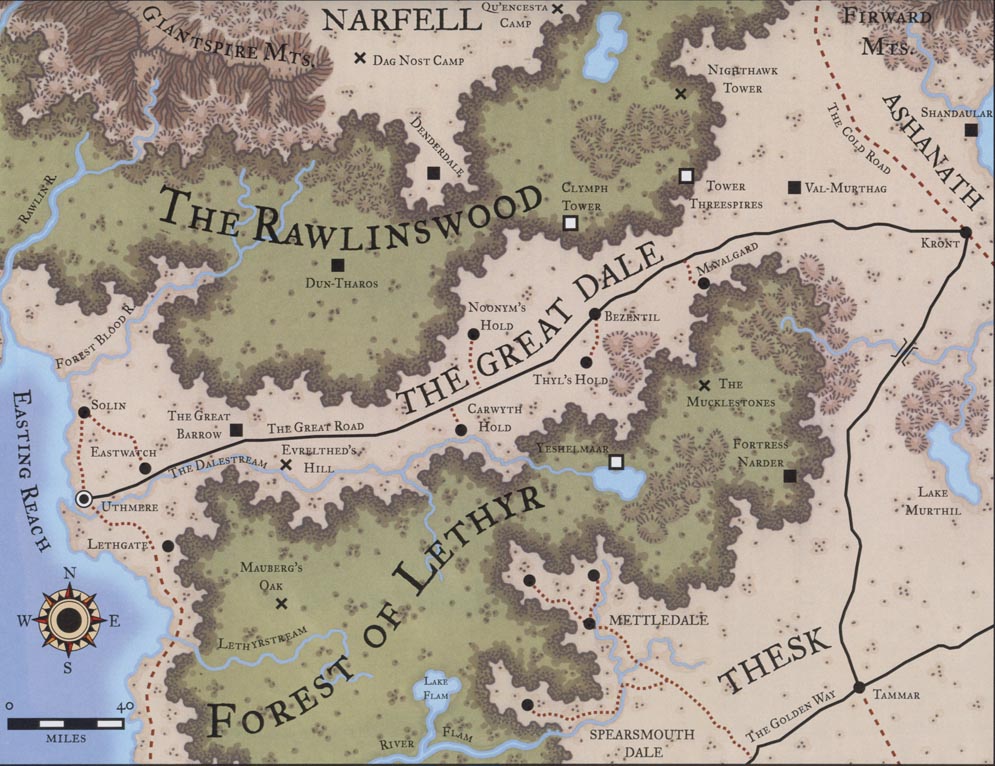
Some months ago, I made a vain effort to put start a new series of posts based on turning the Great Dale into a fairly old school sandbox with several large dungeons just sitting there waiting to be explored. This was largely based on trying to answer the question: "What would happen if you tried to set adventures by Necromancer Games in the Forgotten Realms?"
I also had some other motivations:
- My Neverwinter: Year of the Ageless One campaign was (and still is) coming to an end and I wanted to be able to offer my players something less plot-driven and more location-driven, per some of our games of decades ago. (It turns out that's not what they want! :) )
- I live in hope of converting some of my wife's family and friends to tabletop gamers. We live in the Philippines where the real unemployment rate is around 60% (the government numbers are wrong) and a lot of people play the World of Warcraft clone/offshoot DotA. You would think those two data point would combine into a pool of players for D&D but it doesn't. I will probably end up bribing some of them to try....
- Clearly 5E is very popular and I want to make sure I have something on this blog that 5E fans can use, particularly seeing how (surprisingly) popular my expansion of the Lost Mine of Phandelver turned out to be. So, while I am running 4E, there is nothing here that is going to be 4E-specific: it's all just D&D. (I was hoping to fill the 5E void on this blog by expanding on Princes of the Apocalypse but I just cannot get excited about it.)
So, consider this a revision of <this post> and an attempt to outline a Great Dale-based campaign that is less sandbox but still not quite a railroad.
Warning: This is a long post. In view of my previous botched start to a Great Dale-based series of post, I want to make sure this first post had enough content to help someone get off to a flying start with a Great Dale-based campaign even if I never post on the subject again. So, if Demons & Dragons in the Realms interests you, please keep reading!
Introduction

The Great Dale is described in the 4E Forgotten Realms Player's Guide (from which the map to the left is taken) as follows:
The Great Dale is the vast, windswept vale that divides two enormous forests, the Dunwood to the north and the Forest of Lethyr to the south. The druids and other folk who inhabit the great rocky tor of Yeshelmaar are all that stand between the sparsely settled, wild southern woodlands and the festering evils of the northern forest.
Trade has collapsed along the Great Road, leaving the defenders of Yeshelmaar as the last bastion of civilisation in the Great Dale. Demons that were bound beneath the Dunwood by the long-fallen Empire of Narfell now stalk the northern forest and threaten to overwhelm the wild reaches of the Forest of Lethyr. The southern woods are home to hidden wood elf villages and a handful of human settlements along the border with Thesk.
Three major dungeons are noted on the map: Val-Murthag, Clymph, and Dun-Tharos. These are the three dungeons I am referring to in the campaign's title of Dungeons of the Demonlands. And the order that I have just used to list them is also the order in which I think they are best played. More on that shortly.
The Demonlands
For those unfamiliar with the term "Demonlands" in the context of the Forgotten Realms, these are the lands that were once part of the demon-summoning and -worshipping ancient empire of Narfell. The 4E Forgotten Realms Campaign Guide describes the Demonlands as follows:
This region consists of isolated territories of tough folk, hardened by decades of conflict with demonic beasts and fell magic. It includes Impiltur, Damara, Vaasa, Narfell, and the Great Dale. The region saw a glimmer of hope when King Gareth Dragonsbane united Damara and Vaasa into the unified kingdom of Bloodstone, and when young King Imbrar II of Impiltur dissolved the council of paladins (the Lords of Imphras II) and began ruling unfettered by the dynastic machinations of the past. This prosperity was not to last. The assassination of Dragonsbane’s heir twenty years ago led to civil war throughout Bloodstone, allowing the patient Warlock Knights to seize control of windswept Vaasa. King Imbrar’s death and the retreat of the Inner Sea in the Year of Blue Fire ended Impiltur’s hopes. The kingdom is now firmly in the grip of the Fraternity of Tharos, a fanatical cult of demon-worshipers. Demons freely menace the Dunwood and terrorize the villages of the Great Dale and frigid Narfell.
If I do end up running this campaign and the players which to continue further, I would expect to add adventures in both Narfell and Impiltur possibly with a goal to permanently removing some of the evil which makes the Demonlands such an apt name for these lands.
The Dungeons
While the <3.xE-era map> of the Great Dale shows several other dungeons - including Fortress Narder, the Great Barrow, and Tower Threespires - I'm just going to focus on Val-Murthag, Clymph, and Dun-Tharos, at least for now.
My plan is to give each of the locations a fairly distinctive theme to both aid in shaping my design of the dungeon and also so that the PCs can prepare accordingly.
(Each of these locations will eventually get their own blog post but I also wanted to make sure this [revised] introductory post had some meat and not just bones.)
Val-Murthag
The FRCG says this about Val-Murthag:
This sprawling city was leveled by the Raumathari long ago. Its cyclopean walls and shattered towers lie in a wild and lonely corner of the Great Dale. Little is left on the surface, but deep vaults filled with imprisoned demons and restless Nar ghosts lie beneath the city’s numerous keeps.
3.xE's Unapproachable East describes it as follows:
North and east of Bezentil lies the wreckage of the old fortress of Val-Murthag, one of the largest Nar ruins not covered by forest. This great castle stood watch over the eastern approaches of the Dale, a formidable rampart in the path of any attack from Raumathar to the east. Val-Murthag was a place of madness and horror, the spiritual center of the demonic cult that dominated the dark empire's final days, and Raumathari battlemages visited untold destruction on the place in the final battle of the two realms. Little of Val-Murthag remains to be seen, except for sprawling old walls of weathered black stone that run for miles across the cold downs and the shattered stumps of watchtowers amid heaps of battered stone.
The ghosts of Nar demonpriests are said to haunt the ruins, and most of the Dalesfolk give the place a wide berth.
My version of Val-Murthag is going to be undead-heavy, consistent with the mention of restless Nar ghosts (4E) and ghosts of Nar demonpriests are said to haunt the ruins (3.xE). I would also expect to see cultists of Orcus here and maybe even an adventure inspired by Keep on the Shadowfell. (While I hate that adventure and consider it to have played a major role in the failure of 3E, the basic idea of a cultist of Orcus trying to open a portal to the Shadowfell would suit this location really well.)
Beyond that, the nature of the ruins suggests a collection of mini-adventures - aka dungeon delves, aka five-room dungeons - with most having an undead and/or Orcus-related theme. There may also be room for gnoll cultists of Doresain the Ghoul-King.
Clymph
While the map simply shows the name Clymph, the FRCG gives this location a longer name:
Oracle of Fortress Clymph: The rocks and bricks of these ruins glow red with heat, and the crackling of massive flames emanates from a central fortress. The stones of the keep are imbued with powerful protection magic, transforming the perimeter of the building into a massive magic circle. Before the Spellplague, the magic barrier contained a portal that opened to the Abyss. Though that gate has been closed for nearly a hundred years now, and most of the demonic hordes within have succumbed, fiendish presences yet linger here.
In recent years, Clymph has become known as an oracle site. Those brave or desperate enough can approach the fortress’s front gate, knock three times, and wait to be addressed by a booming voice from the earth. The petitioner is allowed one question, but the answer is whispered so quietly that an ear must be laid to the gate to hear the answer. Many supplicants leave unharmed, happy with what they have learned. Others are absorbed through the gate into the fortress’s interior, never to be seen again.
The portal to the Abyss was open during the era in which Unapproachable East was set:
Once a proud, walled keep, Clymph Tower has lain in ruins for as long as anyone can remember. A mighty sorcerer named Clymph built the place nearly five hundred years ago. Clymph is also believed to have constructed Tower Threespires, for the two sites have a similar architecture and were built around the same time. Clymph Tower has remained untouched for decades, though, and the locals believe it is cursed for some transgression of its fabled builder against the gods.
The best story - or at least the one that gets repeated the most - is that Clymph was a powerful demonbinder, a student of the forbidden arts of ancient Narfell. He dreamed of forging a kingdom in the Great Dale with his demonic armies. He constructed this keep as a pen for his foul servants and imbued its very stones with abjurative magic, transforming the perimeter of the building into a massive magic circle. He then created a permanent gate directly into the Abyss. Unfortunately, Clymph was unable to control the demonic hordes he summoned, and his fiendish minions destroyed him. However, he had crafted his demon-trap so well that the fiends could not escape except through one portal leading to Tower Threespires, and that door is sealed. Dozens, perhaps hundreds, of demons are still trapped in the fell tower Clymph raised centuries ago.
Today, those few people who dare to approach the ruins report that its stones glow red with heat and that massive fire crackle from the depths. Even the most daring adventurers give the place a wide berth.
I wasn't a fan of the oracle idea on my first reading of the FRCG but it does offer an interesting adventure hook. But I suppose the more obvious adventure hook is to have someone trying to re-open the original portal to the Abyss.
The oracle idea makes me think that Clymph would be a great location to contain an imprisoned aspect of Fraz-Urb'luu, the demon prince of deception, but that doesn't quite match the description of the fiery heat of something in the tower. Of course, the two things don't have to be directly related... and Fraz-Urb'luu is known to have the ability to convince another demon that it has been summoned. What if the aspect summoned a fiery horde from the Abyss - or even a balor? - in an effort to fight off the bindings being placed upon it?
I was also thinking that this might be a good location to host a force of Red Wizards of Thay. At the end of the 3.5E era, Szass Tam slew Nevron the Zulkir of Conjuration who ended up in the Abyss as a mane. What if Nevron's descendants/loyal servants (there is a timeline issue with the latter option) are here to try and free him from the Abyss as part of a larger goal to see Szass Tam's rulership of Thay ended and the Zulkirs restored?
Beyond the Red Wizards, I imagine there are also Nar cultists of Fraz'Urb'luu present at Clymph Tower possibly trying to find a way to free the Prince of Deception.

However, it would make more sense in the context of the history of the Demonlands for Eltab to play a role in at least one of these dungeons and this one is arguably the most likely of the three. In such a case, it is Eltab - or an aspect of Eltab or one of his glabrezu or succubus servants - who provides the oracular services, so to speak. Actually, a succubus thrall of Eltab trapped in a demoncyst beneath the tower makes a lot of sense as the oracle. (And if you don't know what a demoncyst is, I explain it after Dun-Tharos.)
And I even have a picture of a Red Wizard thrall of Eltab....
Dun-Tharos
The final dungeon arguably offers the most potential and maybe even deserves to be designed as a megadungeon akin to Rappan Athuk considering the role it plays in FR canon. The dumbed down version in the FRCG says this:
This half-buried ancient city sprawls for miles through the pines and bogs at the heart of the Dunwood. It was once the seat of a great and terrible realm of dark keeps and sinister lords. In a war between ancient Raumathar and Narfell, some mighty spell of unspeakable power leveled the entire area. So ended the demon-haunted kingdom of Narfell.
Nentyarchs of ages past raised a living fortress of magical trees over the ruins of Dun-Tharos, chasing off explorers lest they awaken the dire forces buried beneath. Treasures of Narfell’s baleful lords lie in deep storehouses and conjuring chambers under the old ruins. The Rotting Man drove out the Nentyarch and the Circle of Leth, disturbing those ancient secrets and, before his fall, unleashing an even worse power.
Now demons of every shape move through the catacombs of Dun-Tharos and the forest above. Any creature that comes looking for ancient Nar treasuries risks much.
Actually, that's not too bad a description and there is also a sidebar noting the presence of petty demon lords:
Several powerful demons claim territory above and below Dunwood. Two of them are briefly described here.
Eschar: A powerful demon who commands others of its ilk in Dun-Tharos, Eschar is similar in form to a big, scaled ogre. A crown of horns protrudes from its head and glows with fiendish light. Evil pulses from Eschar like a heartbeat ringing up from the depths.
The Queen Abiding: Also claiming power in Dun-Tharos, the Queen Abiding is a blot of darkness a dozen yards across when she expands to her full diameter. The chill of coldest winter enshrouds her.
I could probably use Eschar if I need a big dumb brute and The Queen Abiding might make for an interesting sub-level of the dungeon-proper.
Unapproachable East provided a bit more detail:
Once the capital of the ancient Empire of Narfell, Dun-Tharos sprawls for miles through the pines and hogs at the heart of the Rawlinswood. From this place, the Nentyarchs (as the rulers of ancient Narfell were known) ruled a great and terrible realm of dark keeps and proud, sinister lords. Dun-Tharos was laid waste in the final cataclysmic war between Raumathar and Narfell, the entire city leveled by some mighty spell of unspeakable power. So ended the Nentyarchs and their demon-haunted kingdom.
Centuries passed, and the forest grew over the great black scar in its heart. A group of druids and rangers - the Circle of Leth - undertook the work of healing the wounded land, Their leader took the title of Nentyarch anew to signify that the druids of Leth ruled over the heart of ancient Narfell. In the ruins of Dun-Tharos, the new Nentyarchs raised a fortress to govern the great forest. The black keep of the old demonpriests was reborn as a castle of living trees, woven by druidic magic.
From this forest-castle the Nentyarchs ruled for nearly six hundred years, preserving the Forest of Lethyr and the Rawlinswood from encroachment by human kingdoms on all sides. The ruins of the old Nar capital reminded the druids of humanity's ability to harm nature, and the forest that had swallowed its black stones offered an example of what might be accomplished with patience and strength.
All things come to an end, though. Ten years ago, the Rotting Man, Chosen of Talona, began to gather a circle of dark druids in the western reaches of the Rawlinswood. The Circle of Leth fought against the rising power of the blightlords and contained the Rotting Man in the west, but two years ago the Rotting Man created a terrible new weapon to use against the Nentyarch - the blight of Talona. He corrupted a handful of captured Leth druids, changing them into blightlords who serve him. Through these tortured minions, he ensnared hundreds of volodnis and infected them with Talona's blight. At Midwinter in 1371 DR he hurled his blightspawned army at the Nentyarch's fortress and drove the Circle of Leth out of the Rawlinswood.
Dun-Tharos is still a castle of trees, but they are now dead, animated through the Rotting Man's foul sorcery. Hundreds of his minions lurk in the ruins of Narfell's old capital, ready to surge forth and slay at his command. His blightspawned warriors slaughtered the small community of Denderdale, north of the forest, only two months ago, and bands of evil volodnis harry the clanholds and farmsteads south of his forest. Dun-Tharos has become a place of death and madness once again.
I must admit, I would not have updated that write-up for 4E and I might keep the Rotting Man... but I would make him a dark druid of Demogorgon.

Ahhh, yes, Demogorgon. It seems the Big D is going to be playing a major role in the Rage of Demons storyline for 5E judging from the art that has been commissioned/published, including this 10-second video to the left. Demogorgon seems like a good replacement for Talona as the Rotting Man's patron/sponsor.
In truth, the real reason I want to include Demogorgon is that I have a miniature aspect of Demogorgon that I have never been able to use and I don't want to waste it. (Yes, I am being completely honest.)
The Grand History of the Realms included this timeline entry that ties the drow to Dun-Tharos:
–10400 DR: Dark elves of Clan Sethomiir travel by magic to the Riildath (present-day Rawlinswood and Forest of Lethyr) from Ilythiir, guided by the hand of the balor Wendonai. They construct an underground fortress named Narathmault [–10000], “the Dark Pit,” at the site of present day Dun-Tharos, recognising it as a place of great evil.
The nature of that "great evil" is not explained but I rather like the tie-in with the drow and with a named balor. I cannot help but think of this piece of art commissioned from the soon-to-be-released Sword Coast Legends CRPG and wonder if I might end up using it to depict a couple of significant NPCs in this campaign: 

At the very least, I rather like the idea of including a dungeon level which I will call the Dark Pit of Narathmault where a band of drow wizards and/or sorcerers are seeking to increase their personal power. (And for campaigns where the Demon Weave storyline from 4E's Rise of the Underdark is going to happen, this is probably a logical place for the drow to perform some of the necessary rituals. It also provides an alternative starting location for the Rage of Demons storyline.)
I also really want to include a traditional, old school, fireball-throwing, Demogorgon-created death knight in Dun-Tharos. And if Demogorgon is going to be involved, I should also use troglodytes, some yuan-ti, and maybe some awakened apes (see The Lost Temple of Demogorgon from Dungeon 120 for some ideas relating to awakened apes).
Demoncysts
As I expect that demoncysts are going to play a significant role in the campaign, I thought I better address them in this post rather than later. And to do I will defer to George Krashos over at Candlekeep:
The Narfelli bound demons into magical prisons known as demoncysts. The demoncyst form of trapping demons commonly occurred on the outer fringes of Narfelli lands (i.e. as a type of border security) to be called upon by Demonbinders as needed and was the least sophisticated means of compelling demons to service used by the Narfelli. The demoncyst ritual involved summoning the demon in question to the Prime and then using their own unique variant of the 'Imprisonment' spell to entomb the demon (or 'drith' in the Narfelli tongue) at a particular location.
What the Narfelli realised early on in the process was that the extra-planar nature of drith made a normal 'Imprisonment' spell prone to collapsing over time, which of course led to much devastation and trouble when an unbound demon appeared 'out of no-where' and started to run amok. This led to the Narfelli working on a more demon-oriented variant of that spell which proved much more stable - but not completely so. As such it was common for only relatively minor drith to be bound in this fashion (usually nothing more powerful than a chasme, more often a handful of dretch or rutterkin) and for there to be safeguards put in place to prevent unleashed demons from doing their own things if unleashed incorrectly. Those safeguards usually took the form of spell-trigger magics to banish said unleashed demon(s) or other types of ward magics to prevent their freedom of movement. As with all dealing with extra-planar creatures, the efficacy of such spells varied wildly on circumstances and the unpredictability of the Art.
I note that there were more than a few Demonbinders who refused to 'play by the rules' and used demoncyst magic to build secret sentinels/armies in more populated areas (i.e. in and around Narfelli settlements) and also were lax in placing appropriate safeguards on their demoncysts - so essentially, anything goes in this regard.
Most 'sanctioned' demoncysts needed to be recognisable to Demonbinders - for it was intended that they be an intrinsic aspect of the defence of the realm and so required to be accessible to all 'army personnel as it were - and so the releasing of subject demon(s) was by way of command word and the touching of a particular item (usually a small brass engraved disc) located at the site of the cyst. Most Demonbinders used "permanency" on themselves to give them the power of a lower-level variant "arcane sight" spell that allowed them to see drith summoning magics (specifically for location of demoncysts and wards against demons) and so could readily observe and activate such sites.
With the passing of the centuries, the demoncyst magics have all degraded to a degree. They are far less stable and accordingly, sometimes simply touching the brass disc located at a demoncyst site without uttering the command word is enough to release the demon(s) in question. It must be noted that the demoncyst ritual was keyed specifically to humans, so the touching of a disc by wild animals, elves, dragons, dwarves etc would all (usually) have no effect. Similarly, disturbing the area of ground at or nearby to a demoncyst by digging, ploughing, etc. has been known to unleash the demons entombed there. Most denizens of the Great Dale do no digging at all if it can be avoided - experience having taught them that the simple act of digging a grave can lead to deadly consequences. Customs in the Great Dale are modified accordingly (they cremate their dead rather than bury; they use hammered in stakes with stout ropes to hold wooden dwellings in place rather than digging stone foundations; etc.).
The largest concentration of demoncysts is located on the southern edge of the Great Dale along the northern part of the Forest of Lethyr, around present-day Mistbridge and the Falls of Erech, near the Citadel of Conjurers in Impiltur and in and around the environs of Dun-Tharos. This is despite centuries of "clean up" by the druids of the region.
I also want to make a demoncyst the centrepiece for my introductory adventure for the campaign.
My original plan was to use Uthmere as a fairly logical starting point for a Great Dale-based campaign... but that would make Dun-Tharos the nearest of the three dungeons which doesn't make sense when it's the most dangerous. Kront, however, is the nearest settlement to the first dungeon of Val-Murthag and it's also on a major trade road leading to Narfell and places north and Thesk and places south. Also, Lake Ashane is close by offering easy access to Rashemen. I mention these places because these are all good places from which PCs might come, although the Great Dale itself is a really good origin point.
The FRCG says this about Kront:
Trade Village; Population 400
The first glimmer of civilisation along the Cold Road from N’Jast in Narfell, Kront stands on a crossroads that leads to Two Stars in Thesk. Despite raids from far-roaming Nars, the rough frontier village still stands. No lord higher than the current Lady Chinilvur, of an Impilturan noble line, claims dominion over Kront. The Chinilvurs would have built the town in the Ashanath on Lake Ashane, but that stretch of land is prone to unnaturally regular and severe tornadoes.
Unapproachable East provides (as is to be expected) a bit more information:
Kront is a neutral trading ground for the surrounding lands. The merchants who regularly pass through here appreciate the lack of politics, especially since this translates into no direct taxes or tolls. The people of Kront make their living trading goods and services with travellers. Kront concentrates on providing services to traders, but it's also a key point for folk from hundreds of miles around to purchase tools and other items they cannot fashion on their own. Many merchants who start out thinking of Kront as a rest stop on their way to other points have decided this is a fine place to trade as well. In particular, fisherfolk come here every day to hawk their catches from Lake Ashane, providing fresh fish for those staying in Kront and smoked meat for them to take on their way.
I'm definitely going to have to flesh that out a lot more if I'm going to use it as a home base (unlike Uthmere where there is a lot of canon info, particularly from the 3.5E era).
Obviously, this is going to develop further as I do further research and design on the campaign but here's my rough outline for what would be a campaign for the Heroic Tier in 4E covering levels 1-11 or so (and arguably the same in 5E):
Adventure One: Dungeon of the Demoncyst
Levels 1-2
I cannot write a proper introductory adventure without knowing the characters but the basic idea combines a dungeon with a demoncyst. Essentially, the seals on a demoncyst have been degraded by a combination of time and the rituals of a Nar demonbinder thus freeing some fairly minor demons (manes, dretches etc...) which are now running about near Kront. The PCs are hired to put an end to this threat which involves delving a Narfelli-era dungeon, fighting Nar barbarians, before dealing with a Nar demonbinder and his minor demon "horde".
Adventure Two: Ghosts of Val-Murthag
Levels 2-5
Deciding to explore the ruins of Val-Murthag, the PCs find that Nar cultists of Orcus have disturbed many of the Nar ghosts. A Nar demonpriest of Orcus is trying to raise a great army of undead from the ruins by opening a portal to the Shadowfell in an ancient temple of Orcus and it's up to the PCs to stop him (or her).
Levels 5-8
The Rashemmi PCs in the party have heard that Red Wizards of Thay have occupied Clymph Tower. It's up to them to determine if this poses a risk to Rashemen and to stop the Thayan schemes.
Or not.
After all, they may be trying to bring back the former Zulkir Nevron in an effort to end the rule of Szass Tam.
Or not.
After all, they may be trying to bring back the former Zulkir Nevron in an effort to end the rule of Szass Tam.
Adventure Four: Dark Pit of Dun-Tharos
Levels 8-11
The corruption of the Dunwood has been increasing and now Kront and other formerly (relatively) peaceful settlements of the Great Dale are threatened and all the signs point to Dun-Tharos being the origin of these troubles.
With support from the druids of Yeshelmaar, the PCs set out to end the threat only to discover a major Nar cult of Demogorgon that has summoned an aspect of the prince of demons to the Realms with the side-effect of corrupting everything around Dun-Tharos.
Delving deeper into Dun-Tharos, the PCs eventually come to the great twin altar of Demogorgon and there seek to banish the aspect of Demogorgon from the Realms before its corruption and madness spreads further!
***
I've written the synopses as railroads to save time but, when I come to preparing the posts for each adventure, I will make sure to include a variety of hooks and also to provide better links between the adventures than what is apparent here.
Table of ContentsFinally, here's the revised table of contents. I will edit in the links to the relevant posts as they are made.
Adventure Locations
From the 4E map:
Clymph Tower
Dun-Tharos
Val-Murthag
From the 3.xE map:
Fortress Narder
Great Barrow
Tower Threespires
Other Locations & Features
Dun-Tharos
Val-Murthag
From the 3.xE map:
Fortress Narder
Great Barrow
Tower Threespires
Other Locations & Features
Bezentil
Dunwood
Easting River
Forest of Lethyr
Giantspire Mountains
Great Road
Kront
Lake Ashane
The Mucklestones
Narfell
Tammar
Thesk
Uthmere
Yeshelmaar
Dunwood
Easting River
Forest of Lethyr
Giantspire Mountains
Great Road
Kront
Lake Ashane
The Mucklestones
Narfell
Tammar
Thesk
Uthmere
Yeshelmaar
Helpful Links
WotC posted the sections on the Great Dale from both the Forgotten
Realms Campaign Guide and Forgotten Realms Player's Guide <here>
and <here> respectively.
All of the information from 3.xE's Unapproachable East - one of the best FR sourcebooks, IMO - can be found in four posts on another site: <overview>, <people>, <cities>, and <history>.
A Final Comment: Necromancer Games
As I have quickly re-read this post I realised that there is arguably enough content here and in the links to allow a DM to quickly put together a campaign set in the Great Dale particularly if he or she owns a few Necromancer Games products.
Start with Wizard's Amulet and Crucible of Freya as an introductory adventure and then segue into Rappan-Athuk but set in Val-Murthag. That's really all you need for a long-running campaign. And whatever bits of Rappan-Athuk aren't used in Val-Murthag can be used in Clymph and/or Dun-Tharos instead. Slumbering Tsar could also provide source material for the same locations.
Add a bit of FR flavour by including Nar barbarians and demonbinders, Red Wizards of Thay, witches of Rashemen, and swapping out the deities for FR ones and it will still feel like FR but the work will have been done for you. After all, if you've paid for the products, you may as well use them! :)